Lamborghini reventon


SANT'AGATA BOLOGNESE, Italy ?: A super sports car, yet one that defies comparison ? the Lamborghini Revent?s both an ultimate driving machine and limited work of art ? with a total of only 20 built and a price of one million Euro (excl. tax), every Revent?s highly exclusive and virtually unique. The Revent?earing the number 20/20 has now been delivered to its proud owner ? thus completing the series.

Highly skilled craftsmanship

Each Revent?as produced with extremely skilled and high-precision craftsmanship in Sant?Agata Bolognese, the home of the brand and the birthplace of all super sports cars bearing the sign of the bull. ?The Revent?however, is the most extreme of all ? a superlative on wheels. Based on the technical underpinnings of the Murci?go, we have concentrated and further enhanced the brand?s DNA ? its genetic code,? says Stephan Winkelmann, President and CEO of Automobili Lamborghini S.p.A., who personally handed over Revent?umber 20 to its new owner at the factory.

Enjoy the incomparable driving pleasure

20 friends and collectors of Lamborghini cars ? who all wish to remain anonymous ? now own this unique piece. Most of them view the Revent?ot only as the highlight of their collection, but also want to enjoy the intensity of the incomparable driving pleasure. Ultimately, the Revent?aside from its extreme form, boasts the full technical and dynamic competence of Lamborghini?s 12-cylinder sports cars. This means the breathtaking performance of 650 hp and a top speed of 340 km/h. It also means absolute reliability and the feasibility of everyday use.

A future legend

This offers all other Lamborghini fans the chance of at least occasionally coming across a Revent?be it on a beautiful mountain road, at the side of a race track or at an exclusive social event. And one thing is also certain ? in future, a few of the 20 Revent?ill be available for admiration in a museum. Because Lamborghini has not only created a design masterpiece, it has also added another classic to the rich history of the brand. The lucky owners can be justly pleased.

Source : www.theautochannel.com (12/9/2008)


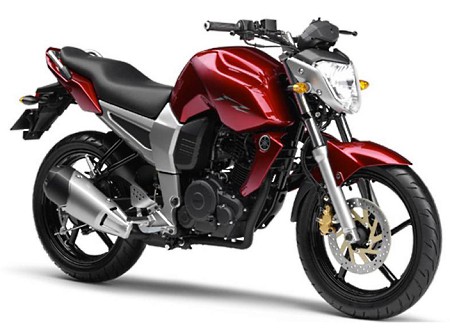
Yamaha FZ-16 Technical specifications


Brand: Model: FZ-16
Dimension & weight
Overall height 1045 mm
Overall length 1975 mm
Overall Width
770 mm
Wheelbase 1335 mm
Ground Clearance 160 mm
Kerb weight 137 kg
Fuel Tank Capacity 12 liters
Engine
Type Air-cooled, SOHC, 2-valve
Stroke (2/4) 4-stroke

No. of cylinders
single-cylinder
Bore x stroke
58.0 × 57.9 mm
Displacement 153.0 cc
Electrical -
Transmission
No. of Gears Return type 5-speed
Clutch
Constant mesh wet multiplate
Performance
Maximum Power 14PS @ 7500 rpm
Max. Torque
14 N.m @ 6000 rpm
Start Electric Start
Suspensions
Front Telescopic
Rear Monocross
Brakes
Front Hydraulic single disc
Rear drum
Tyres
Front 100/80-17
Rear 140/60-R17

Civic vs Corolla Altis


It’s clear from the outset that the new Civic and the new Altis are head-on competitors, says AutoCar (Oct. ’08).

While the Civic is slung marginally lower and sportier, the Altis looks more aggressive with strong styling cues. However it is the Honda that flaunts the more cohesive design, the better build as well as superior look and finish. Quality inside the Altis is a big improvement over that of the previous Corolla, but the Civic still has a clear edge.

The new Altis wins the rear seat test. It is easier to step in and out and the Toyota offers a bit more room too in the rear. Also the Altis is feature rich compared to the Civic. From powered seats for the driver, to HID headlamps with automatic washers, spilt seats for the rear, steering wheel mounted controls, automatically dimming rear-view mirrors, a rear sun blind, trip computer and even cruise control. The Civic has none of these.

The Corolla impresses as soon as you drive it. The motor is very tractable and half throttle is all that’s needed to overhaul traffic. Toyota’s use of a shorter third gear is perfect for city driving and with taller 65-profile tyres, the Altis coasts over bumps.

By contrast the Civic is less at home in the city, observes AutoCar (Oct. ’08). The Civic uses harder shorter-travel springs which make the drive stiffer. Like the Altis, it uses 65-profile tyres and luckily the gearbox of the Honda is light, slick and direct as opposed to the Altis which needs more effort. The Civic has a quicker steering with good body control and darts into corners quite well.

The Altis falls short of the Civic as a driver’s car. Not as stable at speed on its taller spring, shorter wheelbase and non-independent rear suspension, the Altis is a somewhat lacklustre drive.

Delivering comfort, performance, generous features and decent fuel economy
, these two are probably the best cars you can buy rounds up AutoCar (Oct. ’08)

The new Altis is comfortable on the inside and better equipped but it lacks that all-important luxury feel. The Civic on the other hand delivers bagfuls of the feel-good factor with its high quality cabin, refined motor and stunning futuristic design.

The Altis’ motor is more responsive at low-engine speeds and so are equipment levels. But that’s not nearly enough to unseat the Civic and since there isn’t too much difference in the price, the Honda still rules, quite easily actually.


What’s Next?

AutoCar (Oct. ’08) takes a sneak preview of some high technology components that are coming soon to India from Bosch.

While Bosch has concentrated heavily on localising common-rail diesel systems for use in India in the past, the coming years will see them branch out into low cost common rail systems, direct-injection petrol, anti-lock brakes and hybrid systems.

Taking up the challenge of one and two cylinder diesel engines, Bosch will provide low-cost common rail systems for low priced cars like the Tata Nano as well as CRDi systems for single-cylinder auto-rickshaws. The system is designed for engines that range between 700 and 820cc and will be able to put out between 24 and 46bhp, with torque upto 9kgm possible. Bosch will also be helping Indian manufacturers export their diesel cars by meeting international emission norms. The company is already working on De Nox systems (catalysts that convert harmful nitrogen oxides to harmless oxygen) for India.

Along with direct fuel injections another advancement that could be introduced in India are high pressure magnetically-controlled Piezo injectors that can spray multiple patterns via seven individual jets. Explains AutoCar (Oct. ’08), “Though the pressure in the system is a mere 200 bar compared to 1400-1600 bar needed in a direct-injection diesel, this innovative system has a very promising future.”

Next on the cards is localising and cost-cutting anti-lock brake systems. So in the future it could cost you less than Rs.10, 000 to equip your car with ABS. Mild hybrids will also be launched in the near future. The system will automatically stop the engine and start it again as one moves off. The Mahindra Scorpio will soon be the first Indian vehicle to feature such a system.

VOLVO S80 OUT FOR A SPIN


The best time to take Volvo’s 315bhp S80 V8 out for a spin is when the roads are empty, suggests AutoCar (October 2008). The large Volvo slips effortlessly into the night, despite its formidable weight of nearly two tonnes and the S80’s suspension seems to skip lightly over the bumps, as the V8 tugs it forward at just a hint of a throttle.

Though the S80 doesn’t have massive torque, there’s enough enthusiasm in the motor to get you to 2500rpm double-quick. As you mash the throttle further, the gearbox jumps a couple of gears down, dropping the motor right into the powerband at 500rpm and the Volvo shoots forward like an arrow. And this rate of acceleration just keeps going and going and going.

The secret of its virility, supposes AutoCar is its short stroke and large piston bore. The pistons don’t need to travel a long way up and down and that means they can respond faster. Engines with long strokes make better torque, but with almost four-and-half litres and eight cylinders there’s more than enough torque at hand.

It’s also hard not to notice how comfortable you are in the cabin. Sporting some very high quality leather with attractive stitching and piping, the seats are at least 15 percent larger than even a Mercedes E-Class.

While the dark tan seats, cream piping, dark wood trim and the sliver ring around the thick wooden steering wheel all look suitably upmarket, the best bit is the Dynaudio music system. And you get DVD screens for the rear seats as well.

Of course the S80 V8 is not for everyone warns AutoCar (October 2008). It’s not likely to give you a better average than six kilometres per litre and fuel bills will be forty percent higher.

Costing as much as the six-cylinder Merc E280, BMW 530i and Audi A6 3.2 FSI, the V8 ups in comfort, excitement and thrill and of course given Volvo’s obsession for safety features (352 airbags among them), it will be the safest too.

The BMW 650i

You’d never mistake this car for anything but a BMW states AutoCar (Oct. ’08). A demonstration of quality and precision, the car in question has a potent 4.8-litre V8 petrol motor that develops 367bhp and 49.9kgm of torque. What impresses is the sheer responsiveness of the engine, BMW claim a 0-100kph of a little over five seconds and it seems completely believable when you mash the throttle into the floor. A full assault on the accelerator paddle gives 210kph and a good 30-40kph after that at no extra effort.

The six-speed auto box with paddle shifts works smoothly, but rather unconventionally. You don’t get the regular pattern of ‘tap-the –left-one-to-move-down’ and ‘the-right-one-to-push-up’. You need to push down to downshift and tap behind to move up a gear on either one of the paddles. This takes some getting used says AutoCar (Oct.’08)

Inside the cabin, the leather seats are plush and superior. The plethora of seat and steering adjustments means that few drivers will complain about the driving position though the iDrive rotary control that works the climate, stereo, navigation and phone system takes some getting used to. The rear seats are ideal only for children due to inadequate legroom. The boot has limited space. Te soft-top isn’t so great at keeping noise out but the folding mechanism does work very well, you can’t argue with that reinstates AutoCar (Oct. ’08)

Overall, the 650i has a lot going for it. It’s got a jewel of an engine, it drives and feels like a BMW should and looks quite cool too. At Rs. 79.30 lakh (ex-showroom Delhi) you can rest assured that it will provide the exclusivity that a few other cars can, ends AutoCar (Oct. ’08)

Yamaha yzf-r15 technical specification


Brand: Model: YZF-R15
Dimension & weight
Overall height 1070 mm
Overall length 1995 mm
Overall Width
670mm
Wheelbase 1290 mm
Ground Clearance 160 mm
Kerb weight 131 kg
Fuel Tank Capacity 12 liters
Engine
Type Liquid-cooled, ,SOHC, 4-valve Electronic fuel injection
Stroke (2/4) 4-stroke

No. of cylinders
Single cylinder
Bore x stroke
57�~58.7 mm
Displacement 149 .8 cc
Electrical 12V35W / 35W�{35W
Transmission
No. of Gears Return type 6-speed
Clutch
Constant-mesh wet multi-plate
Performance
Maximum Power 17PS / 8,500 rpm
Max. Torque
15 N.m / 7,500 rpm
Start Electric Start
Suspensions
Front Telescopic
Rear Linked type Monocross
Brakes
Front Hydraulic, single disc
Rear Hydraulic, single disc
Tyres
Front 80/90-17
Rear 100/80-17